Search Stock Exchange News & Tips

Custom Search
Showing posts with label indian share bazar news. Show all posts

Tuesday, June 14, 2011

VMS Industries debuts with 10% premium

Shares of VMS Industries started the trade at Rs 43.95, up 10% as compared to issue price of Rs 40 a share despite lower subscription during the issue opened.

At 9:37 hours IST, the stock was trading at Rs 46.20, with volume of nearly 30 lakh equity shares on the Bombay Stock Exchange.

VMS Industries is engaged in ship recycling activities, off-shore support business activities. It raised Rs 25.75 crore through the issue.

Issue proceeds are proposed to be used for modernization of ship recycling plot, setting up of corporate office at Ahmedabad and for long-term working capital requirement.

Issue was opened for subscription during May 30-June 2 and was subscribed more than 1.4 times. Reserved portion of retail and non-institutional investors was subscribed 3.67 times and 1.24 times, respectively. However, qualified institutional buyers had not shown any interest in the issue.

Saturday, April 16, 2011

Weekly Markets: Sensex drops on Infy nos, inflation data

Markets paused the last three week's rally as traders took to booking profits. Infosys' dissapointing earnings estimate did nothing to help the sentiments which were down with crude oil prices and inflation at high levels.

The holiday shortened week saw the Sensex drop 65 points to 19,386. The index opened the week at 19,383 and touched a high of 19,737 on Wednesday - Tuesday being a holiday on account of Ram Navami. Thursday market stayed shut for Ambedkar Jayanti. On the last trading day of the week index plunged after IT Major Infosys came out with its quarterly numbers.

Industrial production rose 3.6% in February 2011. However, market was expecting IIP growth to be at 4.8%. Manufacturing output rose an annual 3.5% in February 2011. January's industrial output annual growth rate was revised upwards to 3.9% from 3.7%.

The wholesale price index rose 8.9% in March 2011, higher than 8.3% rise in February 2011 and also ahead of market expectations.

Crude oil continued to hover around higher levels. High oil [prices have raised concerns of a widening current account deficit and higher oil subsidy bill.

Infosys reported marginal rise of 2% in its consolidated net profit at Rs 1,818 crore for the fourth quarter ended March 2011 on sequential basis. The company had reported a net profit of Rs 1,780 crore in the December quarter. For the quarter ending June 30, 2011 the company expects revenue to be in the range of Rs 7,311 crore and Rs 7,382 crore; growth of 18.0% to 19.1% y-o-y.

"The results were tad below expectations. At Rs 3306, if Infosys had delivered 25-30% topline and 15-20% bottomline growth, we could have seen more upside on the stock. The scrip is down 7% due to profit booking," said Gaurang Shah, AVP, Geojit BNP Paribas Financial Services.

Infosys was the biggest loser among Sensex stocks, plunging 7.3% to Rs 2,989. Other IT stocks dropped. Wipro tumbled 3.5% to Rs 450. TCS ended flat at Rs 1,190. Other losers included Core Projects, Oracle Financial Services and Tech Mahindra.

IT index, as a whole, slipped 4.5% to 6,259. BSE realty and metal indices dripped 1-2% each.

Meanwhile, FMCG index surged 2% to 3,713. Bankex gained 0.6% in the week to end at 13,383.

Among banking stocks, ICICI Bank and HDFC Bank ended on a flat note at Rs 1,101 and Rs 2,360, respectively. However, Federal Bank rallied 5% to Rs 445. Yes Bank and IndusInd Bank jumped 3% each. Canara Bank, Kotak Mahindra Bank and Bank of Baroda were up 2-3% each.

Saturday, April 9, 2011

India gains as FIIs divert funds to emerging markets

India gains as FIIs divert funds to emerging marketsWith global investors shifting focus from developed to emerging markets in the last few days, India has emerged as a major beneficiary.

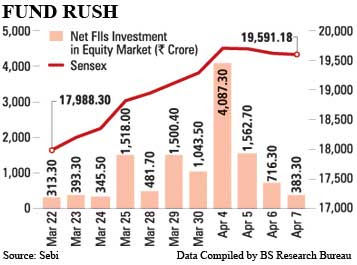
Since March 22, foreign institutional investors (FIIs) have net-bought Indian shares worth Rs 12,345.30 crore, according to data from the Securities and Exchange Board of India. More than half of this, or Rs 6,749.60 crore, has come in just six sessions ended April 7, data compiled by the BS Research Bureau show.

The surge in inflows on March 31, when FIIs invested Rs 3,300 crore, was due to shifting of some funds from derivatives to the cash market on the expiry day, said the head of institutional equities at a domestic brokerage.
The last time such strong inflows came in such a short span was in early November last year, when the Bombay Stock Exchange (BSE) Sensex closed at an all-time high of 21,005.

Not surprisingly, the Sensex, which closed at 19,451.45 on Friday, has gained 9 per cent since March 22.

“For the last few months, investors were exiting emerging markets and deploying money into developed markets. The trend is reversing, with emerging markets becoming relatively cheaper,” said U R Bhat, managing director, Dalton Capital Advisors (India). “Despite oil prices rising, the macro situation in India is looking better, with interest rates peaking and the balance of payment situation likely to be better than expected, on the back of robust export performance,” he said.

Net inflows into emerging market equities were $2.7 billion (Rs 12,150 crore) in the week to April 6, according to Lipper, the fourth-highest since the fund tracker began compiling this data in 1992.

“Following a 20 per cent rally since the announcement of second quantitative easing by the US at the end of August 2010, investors appear to believe that developed market equities reflect the positive outlook and emerging market equities are worth another look,” Clive McDonnell, head of equity strategy at BNP Paribas Securities Asia, said in a note to clients. “An additional factor is the improvement in valuations following the outflow of $25 billion from the emerging market equity universe in the first quarter of 2011,” he added.

Several FIIs have changed their India stance in the last one month. Early this week, JP Morgan’s Adrian Mowat, the Asian and emerging market strategist, upgraded India to overweight, citing lower inflation, normalisation of the yield curve and the progress on various legislation. After March 31, HSBC strategists have changed their India rating from underweight to neutral.

Some other influential foreign firms such as Deutsche, Morgan Stanley and Citi have also been optimistic in their India outlook.

Saturday, April 2, 2011

Wipro to buy SAIC’s IT biz for $150 mn

Software firm Wipro Technologies has proposed to acquire US-based Science Applications International Corporation’s (SAIC) oil and gas IT business in an all-cash deal of about $150 million.

The unit provides consulting, system integration and outsourcing services to global oil majors. “Oil and gas companies are investing in the upstream business, while looking at rationalising cost through IT. The acquisition of SAIC’s global oil and gas information technology practice will strengthen Wipro’s existing Energy business unit,” Wipro Technologies Senior VP (Energy, Natural Resources and Utilities SBU) Anand Padmanabhan said.

“As a result of the transaction, about 1,450 employees are expected to move to Wipro across North America, Europe, India and Middle East,” it said, adding that Wipro’s Energy, Natural Resources and Utilities Strategic Business Unit (SBU) is a high-growth unit and this acquisition will further strengthen Wipro’s leadership position.

www.indianexpress.com

Wednesday, March 23, 2011

Crude oil price will remain a key concern: Kotak AMC

Domestic market has turned volatile on aggressive crude oil prices. In the view of most analysts, India will have to deal with hiking oil rates and inflation numbers at the same time in order to keep the market steady. Alroy Lobo, chief strategist and global head of equity asset management at Kotak AMC feels that higher oil prices will weigh on market sentiments and will remain as a key concern till oil prices come off. In addition to that, global events have been priced into the market and as a result, the revenue estimates will be shaved.

Talking about sector specific growth prospects, he said that he is constructive on the IT and outsourcing service sector. “IT and outsourcing services should show continuous growth in FY12,” he adds. He was also optimistic about the growth of pharmaceutical sector in India.

Besides being neutral on banking sector, he is underweight on infrastructure, real estate and capital goods sector in India. He feels that inflows were weak due to lack of retail participation; however, he sees a fair degree of valuations in the midcap segment.

Reacting on the RBI’s interest policy update, he said, “RBI is likely to hike interest rates to 50 to 75 basis points this year.”


www.moneycontrol.com

Wednesday, April 22, 2009

Banks to get stress test results Friday: report

(Reuters) - U.S. banks will be briefed by regulators as early as Friday on how they performed in government "stress tests," before the results are made public later, The Wall Street Journal reported, citing government officials.


Reuters - The Wall Street entrance to the New York Stock Exchange is pictured March 27, 2009. REUTERS/Eric Thayer ...
Some estimates of likely losses that were used in the stress tests were tougher than expected, the newspaper said.

"Under a more adverse scenario, which assumes a 10.3 percent unemployment rate at the end of 2010, banks would have to calculate two-year losses of up to 8.5 percent on their first-lien mortgage portfolios, 11 percent on home-equity lines of credit, 8 percent on commercial and industrial loans, 12 percent on commercial real estate loans, and 20 percent on credit card portfolios," the paper said, citing a confidential document from the Federal Reserve.

On Tuesday, Treasury Secretary Timothy Geithner said most U.S. banks have enough capital to keep lending, but a pile of bad debts is fostering doubts about their health and slowing a recovery.

An official at the Federal Reserve said last week that results of the tests, designed to see how the nation's 19 largest banks would fare should the U.S. recession prove unexpectedly severe, would be made public on May 4.

The official said regulators will try to prove the rigor of the tests by releasing a document on Friday that explains the underlying assumptions. The document will outline the methodologies employed and serve as a guide on how to interpret the results.

Thanks to http://finance.yahoo.com

Sunday, October 26, 2008

RIL stock skids 66% in the downturn

CHENNAI: From August '07 to January '08 when stocks rallied from strength to strength, Reliance Industries was the catalyst for the the 7,000-point sensex rally. But, ever since the fall started since January 10, it is again Reliance, according to data, may be the chief reason for bringing the benchmark down in the quicker and sharper downturn.
The world may have changed for Indian stocks and Sensex may have come down substantially but the the most influential stock in the 30-share bellwether index -Reliance still remains the match-maker. While the stock price has corrected by Rs 2,000 a share, Sensex came down by 12,500 points.

Extrapolating this, it is fair to say that for every one rupee shed by Reliance stock, Sensex has fallen by close to 6 points, according to analysts. When sensex went up by 49% in just 7 months (August to January) Reliance, which carried a weightage of 15.3% in early January, witnessed its stock price outperform the benchmark index and raised by 73%.

While the DLF stock went up by over 90% in the same period, the real estate company carried a meagre sensex weightage of 2%.

The impact of Reliance's rise is significant on Sensex as blue-chip firms SBI, ITC, ADAG-controlled Reliance Comm and ONGC cumulatively held a weightage of close to Reliance"s 15% in January. "The Reliance stock is pivotal to sensex's fortunes. There has hardly been any day, when Reliance has fallen and has not pulled down sensex alongwith it. Nobody remains unaffected when the big boy falls," said a large broker at Bombay Stock Exchange.

During the downturn, the Reliance stock has fallen by 66%, again outperforming Sensex which has shed 59% in the same period.

Although Sensex constituents such as RCom, Larsen & Toubro and DLF have fallen by 75-80% in the same period, which is sharper than Reliance, the three stocks have a cumulative weightage of just under 10% (which is less than Reliance's 12% influence), data shows.

One half of all Sensex companies taken together i.e around 15 stocks have just the same influence that a single scrip has: Reliance. DLF may have corrected by over 80% but Reliance's freefloat market cap is 14 times more than it. "Sensex is calculated under free-float market capitalisation method.

This means that the influence of closely-held companies such as DLF on the index is preventing even if their stock price fall is much sharper," the research head of a foreign brokerage explained.

Saturday, October 18, 2008

Market crash: Tips to cut losses

THE market's blows are only getting harder.

The bad news is that the worst may not be over yet. Amidst all this turbulence, only one thing can save you: The right advice.

Here’s how you can limit the damage, straight from wealth's experts.

Scenario 1: I invested in the markets for the short term; what should I do now?
Right now, the markets are driven by global sentiment. And, financial planner Arvind Rao reckons that it may take up to the fourth quarter of 2009 for the global market to pull up. On the domestic front too, things may look brighter only in the third or fourth quarter of 2009. "This is mainly because of the huge input costs and high interest rates as of now, " he says.

In such a scenario, you have 2 options:
Option 1: If you are hard pressed for money, you have no choice but to withdraw.

PV Subramanyam, financial domain trainer, says, “If you need money soon, say in a year or two, it is better to sell now even if that means booking losses. There’s no way of predicting how the markets would behave.”

Option 2: Sandeep Shanbhag, investment expert and Director, Wonderland Consultants, says, “If you initially invested for the short term but can weather the storm, then wait, provided you have fundamentally good stocks. However, if you need funds, then exit as early as possible and treat this as a mistake not to be repeated.”

Caution: Do not play the markets on a short term basis simply because of the looming uncertainty.

Read more...... www.Moneycontrol.com

Saturday, September 27, 2008

Sharekhan puts 'buy' on Balaji Telefilms; target Rs 268

MUMBAI: Sharekhan has maintained ‘buy’ on Balaji Telefilms for a target price of Rs 268. The company has denied any plans to launch a Hindi general entertainment channel, dismissing the media reports on the company's GEC plans as pure speculation.

Sharekhan opines that the launch of a Hindi general entertainment channel in the current cluttered and highly competitive scenario will have severe financial implications for the company and also affect its core business of television content. Hence, the brokerage is inclined to believe that the reports of the launch of a general entertainment channel by the company are mere speculation.

The company has launched a new show, ‘Kootukari’, on Surya TV. Earlier ‘Kalyani’, another of its show on Surya TV, had gone off air in mid July 2008. Balaji Television will be offered additional slots on various channels of Sun Network, which will help it, increase the number of programmes under the sponsored segment.

Sharekhan’s interaction with the company's management suggests that the maximum number of programmes that could be launched in the sponsored category can go up to eight against the current four shows. However, despite an increase in the sponsored programming hours, the contribution of the sponsored content business to the company's top line and bottom line shall remain relatively small.

The brokerage has understood that no further development has taken place on the proposed stake sale by STAR. The promoters of Balaji Televisions had been given 240 days (ending April 2009) to buy out STAR's 25.99 per cent stake in the company at Rs 190 per share. Considering the quantum of the amount involved (Rs322 crore), Sharekhan expects the promoters to rope in financial/strategic partners which might lead to an open offer. The open offer would be a trigger for the stock.

Sharekhan’s outlook on the television content business of Balaji Television remains positive, as the company is a scaleable player in a non-scaleable business. However, the near-term profitability of Balaji television would be affected by a drop in the realisations due to the end of the company's exclusivity arrangement with STAR and the going off air of one of its popular shows, ‘Kahani Ghar Ghar Kii’.

At the market price of Rs 148.7, the stock trades at 7.5x FY2010E earnings per share (EPS) of Rs 19.9.
thanks to: economictimes.indiatimes.com

Tuesday, September 16, 2008

Nath takes a dig at troubled US banks

NEW DELHI: Taking a pot shot at the US financial sector, which is facing one of the worst turmoils ever, Commerce and Industry Minister Kamal Nath today said those "preaching" others have not kept their own house in order.

"Those who preached us best practices have not helped their own financial sector," Nath told reporters here when asked to comment on the US financial crisis, worsened by collapse of investment bank Lehman Brothers.

Nath said the amount of exposure of the banks going down is small in Asia. "A very small fraction of that (US economic turmoil) is in Asia. This shows that best practices have been adhered to in Asia," Nath said.

However, he said, the economic turmoil in the US is causing concern to most of the global economies. "It still has to be assessed to what extent it will affect the economy in Europe," he said.

The US credit crisis worsened yesterday with 158-year-old Lehman Brothers filing for bankruptcy protection after losing around 60 billion dollars in the sinking real-estate market. Earlier, the troubled investment bank Merrill Lynch was bought by Bank of America.

Monday, August 25, 2008

S and P launches index of Indian equities for int'l investors

NEW DELHI: Standard & Poor's on Monday launched an equity index of 60-listed Indian companies, including the likes of Infosys, Bharti Airtel and Reliance Industries, to provide international investors with information on tradeable exposure to the largest and most liquid scrips in the country.

"The new S&P India Select Index was developed in response to growing investor demand for access to the leading companies in India. The index has a pool of easily accessible underlying stocks that provides a unique way for international investors to take part in India's growth story," R Ravimohan, Managing Director and Head of South and Southeast Asia, S&P said in a statement.

The 'S&P India Select Index' comprises leading companies, with no single scrip representing a weight more than 10 per cent in the index.

According to the leading index provider, the stocks that have reached the maximum percentage holding for Foreign Institutional Investors (FIIs) are excluded from the index in order to reflect the "lack of access of those stocks to foreign investors."

"The index is fully float adjusted and stock weights are determined by what is legally and practically available to foreign investors," the statement added.

The top 10 holdings by percentage of index weight are Infosys Technologies, Bharti Airtel, Oil and Natural Gas Corporation, Reliance Communications, Housing Development Finance, Reliance Industries, ICICI Bank, Hindustan Lever, Bharat Heavy Electricals, and Larsen & Toubro.
thanks to: economictimes.indiatimes.com

Short covering in Nifty futures; Aug ends flat

MUMBAI: Bouts of profit booking on weak opening of European markets led Indian stocks to shed all early gains on Monday.

National Stock Exchange's 50-share Nifty closed the day slightly higher at 4335.35 and August futures provisionally ended flat to spot. However, September futures settled at 1 point discount, indicating rollovers of short positions in the series.

August futures price gained 0.29 per cent while open interest shed 3.25 lakh shares. Nifty September futures price advanced 0.32 per cent and added 59 lakh shares in OI.

Call writing was observed at strikes 4400 and 4300 of August series and in September at strikes 4500 and 4400.

Put buying was witnessed in August series at strikes 4400 and 4300 levels while September series showed put buying at 4200 and 4000 levels. The options data indicates resistance at 4400 and support at 4200 levels.

"We saw short covering across the counters ahead of F&O expiry Thursday. Markets will remain volatile till the expiry. Data on US and India GDP, due on Aug 28 and 29 respectively, are of vital importance for the markets, also inflation data. Players should utilise every rally to lighten their commitments," said Subrato Basubani, analyst with Spark, a wealth advisory firm.

Realty and banking sectors were the major gainers while metal, power and oil & gas lost the most.

In banking, Bank of Baroda August futures gained 4.5 per cent while the contract ended flat to spot. Kotak Mahindra Bank near month futures price advanced 2.31 per cent and open interest added 1.16 lakh shares. ICICI Bank contract ended in a slight premium to spot.

DLF August rose 1.88 per cent while the contract closed at Rs 5 discount. HDFC jumped 3.36 per cent on short covering. However, HDIL futures dropped 2.17 per cent and shed 8.71 lakh shares in open interest.

Metal and commodity stocks fell on tumbling prices in international market.

Tata Steel futures fell 2.19 per cent, Sterlite Industries skid 0.44 per cent and shed 6.30 lakh shares and SAIL August futures slipped 0.34 per cent with huge additions in open interest, indicating short build up in the SAIL contract.

Total F&O turnover on NSE was Rs 45,979 crore, up 3 per cent from Friday.

Elsewhere, European stocks fell as concern deepened that credit losses will spread, threatening economic and profit growth. US index futures declined.
thanks to: economictimes.indiatimes.com

Saturday, August 23, 2008

Short covering in stock futures, huge call writing at 4300 level

MUMBAI: After an initial hiccup, Indian markets recovered smartly in afternoon trade on Friday on the back of positive opening in European markets. National Stock Exchange's 50-share Nifty closed the day 0.84 per cent higher at 4319 and August futures provisionally settled at a premium.

The August futures premium widened to 10 points from 4 points Thursday. The contract price gained 0.98 per cent and added 10.5 lakh shares in open interest. Rising open interest coupled with widening premium indicates some longs being added in the contract.

Interestingly, huge call writing was observed at 4400 and 4300 levels while 4200 strike saw call buying. On the other hand, 4300 and 4400 puts shed positions in open interest where as 4200 witnessed put writing from bulls. The options data indicates Nifty range at 4200-4400 levels.

"Short covering was observed in banking, metal and auto stocks ahead of F&O expiry next week. Metal stocks gained as weak dollar bolstered the commodity prices in international markets," said Amrit Mehta, an independent analyst.

"The F&O expiry next week may fuel the volatility in the markets. On Aug 29, Indian GDP data for Q1FY09 will be released. This is a figure market is waiting anxiously for. For banking sector, next week will be a tough one. Bounce back in crude prices is expected to continue and it may impact bank stocks," said Praveen Kumar, an analyst with large brokerage

"On Aug 28, US GDP preliminary data will be released. Advance estimates are indicating US economy to grow 1.9% annualized rate. If the actual figure comes in line with the preliminary estimate then it would mean recessionary fears are over and the Federal Reserve can concentrate on inflation fighting and we can expect rate hikes in US," Kumar added.

In stocks futures, Hindalco futures gained 4.17 per cent and Sterlite Industries jumped 3.7 per cent on short covering. Steel Authority of India August advanced 3.67 per cent.

Axis Bank August rose 4.83 per cent, Kotak Mahindra Bank increased 3.35 per cent and HDFC Bank gained 2.16 per cent.

Tata Motors futures gained 1.81 per cent, Mahindra & Mahindra advanced 1.53 per cent and Maruti rose 1.77 per cent.

Total F&O turnover on NSE was at Rs 44,332 crore, down 14 per cent from Thursday.

Meanwhile, European stocks rose as investors speculated takeovers may increase and a drop in oil boosted airlines and carmakers. U.S. index futures advanced, while Asian shares retreated.

thanks to: www.economictimes.indiatimes.com

Friday, August 22, 2008

Prabhudas puts outperformer on Bharti Airtel: target Rs 973

MUMBAI: Prabhudas Lilladher has maintained ‘outperformer’ on Bharti Airtel for a target price of Rs 973. Bharti expects the industry’s wireless subscriber base to reach 500 million by 2010 and 750 million by 2015, implying a compounded annual growth rate of 15 per cent over the period. The company has reiterated sustaining 25 per cent market share.

There are 5-10 slots available in all the circles, except Mumbai and Delhi that will suffice the needs of most of the operators. Mumbai and Delhi have 2-3 slots for auction with around five operators offering 2G services. These two circles being the key markets for 3G services may see serious bidding, says Prabhudas.

Bharti expects the auction process to take place between Sept’08-Oct’08 and launch of services in 6-9 months. However, no datapoints were given on the 3G capital expenditure.

3G will help the GSM incumbents to garner additional spectrum in the key markets for offering voice and high-end services. The spectrum-starved operators would like to ride the 3G services before the launch of Rcom GSM panindia and new entrants like Datacom, Unitech etc. rolling out their network.

Bharti expects to launch its DTH platform by Oct’08, initially targeting 100-120 cities. Test trials on 10,000 employees and associates have shown good results, says the brokerage.

Prabhudas expects Bharti to report strong subscriber additions over the next 5-6 months and has maintained its wireless leadership. Faster access to 3G spectrum shall be the key trigger in the foreseeable future.

At market price of Rs 792, the stock trades at a PER of 15.5x and at an EV/EBITDA of 9x FY10E earnings.
thanks to: economictimes.indiatimes.com

Bargain hunting helps indices close higher

MUMBAI: Selective stock buying by deep pockets and short coverings in banking, metals and auto stocks on Friday saw indices close on a higher note.

The market started off on a weak note on the back of negative Asian cues and rising oil prices. But soon, traders covered short positions in interest rates sensitive sectors as inflation rose moderately. Positive opening of European market bolstered sentiments further.

Metal commodity prices surged on speculation that demand will pick up in China after Olympics and as US dollar continued to decline against basket of currencies.

Capital goods and power space lost momentum as the day progressed on worries of outcome of the second day meet of Nuclear-Supply-Group on India-US nuclear deal.

“Stocks were available at good valuations after yesterday’s fall so some value buying was seen. Market seems to be in a neutral to positive zone,” said Ajay Parmar, Head of Research, Emkay Global Financial Services.

Bombay Stock Exchange’s Sensex closed at 14,401.49, up 157.76 points or 1.11 per cent. The index touched a high of 14,428.52 and low of 14136.86.

National Stock Exchange’s Nifty ended at 4327.45, up 43.60 points or 1.02 per cent. The broader index touched a high of 4337 and low of 4248.

BSE Midcap Index closed 0.34 per cent higher at 5726.85 while BSE Smallcap Index was down 0.16 per cent at 6,925.85.

Biggest Sensex gainers were Sterlite Industries (4.34%), Hindalco Industries (4.26%), Hindustan Unilever (3.73%), HDFC (3.22%) and BHEL (2.76%).

Index losers comprised Satyam Computer (-3.18%), Grasim Industries (-1.85%), NTPC (-1.70%), Wipro (-1.04%) and Larsen & Toubro (-0.88%).

Market breadth, however, remained negative with 1414 declines against 1209 advances on BSE.

Tata Motors may sell stakes in group cos to raise funds

MUMBAI: The possible avenues through which Tata Motors could raise Rs 3,000 crore to bridge the gap between the old and revised rights issue structure, include selling of shares in group Tata companies, both listed and unlisted.

Some of them include Tata Steel, in which Tata Motors held 3.14 crore shares at the end of FY08, which is currently valued at nearly Rs 1,840 crore, coupled with partial dilutions in Tata Motor’s subsidiaries like Korea-based Tata Daewoo Commercial Vehicle and Tata Technologies, point out investment banking sources.

Tata Daewoo’s total income for the year ended March 31, 2008 was Rs 3,069.7 crore while its profit after tax was Rs 158.9 crore. Other immediate liquid assets available to Tata Motors, include its cash and bank balance of Rs 2,397.3 crore at the end of FY08.

Of course, the revised terms of the rights issue will only result in a 42% dilution of the company’s paid-up equity capital of Rs 386 crore, as compared to earlier estimates of 57%, point out analysts at foreign brokerage houses. Tata Motors’ fully diluted earnings per share was Rs 48.28 for FY08.

Tata Motors currently has 85% shareholding in HV Transmissions and HV Axles each. In the past two quarters the company has been diluting stakes in these two companies. HV Transmissions and HV Axles are valued at Rs 1,100 crore.

Incidentally, the Tata group had earlier planned to dilute equity in some of the subsidiaries like Tata Daewoo, HV Axles and HV Transmissions through an IPO. An auto analyst pointed out that since the market is on a downturn, and it would be difficult to get a good price, the main holding company Tata Sons will initially fund. Nevertheless, the Tata Motors stock declined 1.4% to Rs 417.95 on Thursday, given the bearish sentiment on the Street.

In the changed structure Tata Motors has decided to sell certain investments instead of its earlier plan of raising Rs 3,000 crore through issue of the convertible preference shares, one of three instruments of the proposed rights issue. However, other two instruments — issue of ordinary equity shares and offer of equity shares with differential voting rights — amounts to Rs 4,200 crore.

The proceeds of the divestment will be utilised for repayment of the bridge loan taken for JLR acquisition. The company has already monetised some of its investments in this year.

Tata Motors purchased JLR from Ford Motor for $2.3 billion in January. In May this year it announced plans to raise Rs 7,200 crore through the unlinked but simultaneous rights issue. The company also announced to raise between Rs 2,000 crore and Rs 2,500 crore ($500-600 million) from overseas markets through issue of securities. In all, the company plans to raise a total of Rs 9,500 crore to fund the JLR deal.
thanks to :- economictimes.indiatimes.com

Monday, August 18, 2008

Hindalco drops over 4 pc; HDFC surges 3 pc on BSE

MUMBAI Shares of Aditya Birla Group firm Hindalco declined over four per cent, while mortgage lender Housing Development Finance Corporation gained over three per cent, amid the benchmark index Sensex losing 78.52 points to close at 14,645.66 points.

Hindalco, the biggest loser among the 30 blue chips, plunged 4.53 per cent to close at Rs 129.65 on the Bombay Stock Exchange after touching an intra-day low of Rs 128.70.

Another Aditya Birla Group firm Grasim Industries ended the day at Rs 1,963.50, down 4.52 per cent, while more than 16,000 shares of the company changed hands today.

Anil Ambani-led Reliance Communication slipped 2.71 per cent to close at Rs 412.40, whereas corporate giant Reliance Industries lost 2.21 per cent to close at Rs 2,224.95.

Homegrown auto major Mahindra & Mahindra lost 2.56 per cent to close at Rs 568.10, despite the company announcing a joint venture with a Chinese tractor firm.

Among the sectoral indices, Oil&Gas, Metal, Power, Auto, Consumer Durables all closed in the negative territory following the trend of the benchmark index Sensex.

Meanwhile, Housing Development Finance Corporation jumped 3.12 per cent to close at Rs 2,359.75 and more than one lakh shares changed hands on the bourse.

Private sector lender HDFC Bank ended the day at Rs 1,200.40, up 2.14 per cent. It had touched an intra-day high of Rs 1,222 on day's trade.

Other gainers include software major Satyam Computers, engineering and construction major Larsen & Toubro, software exporter Tata Consultancy Services and FMCG firm Hindustan Unilever soared over one per cent on the exchange.

The IT index was the only gainer in the day's trade on the BSE and settled with a gain of 0.75 per cent at 3,926.38 points.

Citigroup cuts S&P 500 year-end target

Citigroup lowered its 2008 year-end targets for S&P 500 and Dow Jones Industrial Average by about 5 per cent due to the weak credit environment, and said a year's worth of tightening credit is only now being felt.

The brokerage cut its S&P 500 target to 1,475 and Dow Jones Industrial Average target to 13,250. "While global economic trends have been weakening, credit conditions continue to deteriorate and point to more bad news that may have not yet been discounted," the brokerage said.

Gold may slip below Rs 10,500 by end of Sept

MUMBAI: In line with the sharp fall in price in global markets, gold price in India is expected to fall below the Rs 11,000 mark per 10 gm by September, a top industry official said.

“Gold prices have witnessed a steep fall in line with the global markets and are likely to drop further and may touch the Rs 10,400 to Rs 10,600 per 10 gm-mark by September-end,” said Bombay Bullion Association (BBA) president Suresh Hundia on Sunday.
Domestic gold prices in July saw an inverted U-shaped trend. Trading initially at Rs 12,900 per 10 gm, it reached the peak of Rs 13,567 per 10 gm by mid-month before beginning its downward journey at the end of the month and finishing at Rs 12,557 per 10 gm, much below the level it had initially begun.
The gold price dropped from Rs 12,705 on July 26 to the present level of Rs 11,300 per 10 gm in the local bullion market. In the international market, the yellow metal dipped below $800 an ounce for the first time since December 2007.
As US economists see improved prospects for its economy, the dollar could be more attractive as an investment, particularly in times of crisis, making gold less lustrous like other precious metals. In the domestic market, gold demand has already started picking up and people have advanced their purchases before Diwali and wedding season, following a sharp decline in prices, bullion traders said.

Market participants expect the metal to test further lows in line with the steep fall in prices.

“The metal is losing its social value and more dependent on the foreign exchange,” said All India Sarafa Bazar president Sheel Chand Jain, adding that every rise in dollar would reduce the appeal of the metal. He said easing crude oil prices have also eroded the demand for gold as a hedge against inflation.
Gold in overseas markets hit an intra-day low of $773.90 an ounce, its weakest since November 20 last year, down from $811.25 late in the New York on Thursday as the dollar firmed up to a six-month high against the euro. Crude oil prices fell to $111.34 a barrel on demand fears. Bullion traders said prices would see more lows in the next few days following a fall in demand among stockists and jewellery fabricators.

Overall, there has been a shortfall in demand for physical gold in India, which usually stands at about 800 metric tonne annually. According to the BBA, India’s gold imports have fallen by almost 50% in the first quarter. BBA statistics said gold imports in the first quarter of this year is 101 metric tonne against 193 during the same period last year.
thanks to: economictimes.indiatimes.com/

Friday, August 15, 2008

SEBI may weigh an alternative system for IPO pricing

MUMBAI: While the dismal performance of IPOs is largely attributed to a sluggish market, it is time to raise a more fundamental question: do we need a relook at the book-building system that’s used to price new stock offerings?

A review of the present book-building norms should figure in Sebi’s agenda on the next round of primary market reforms. According to a source familiar with the subject, Sebi may soon examine whether the book-building process is the most efficient price-discovery mechanism.

“In fixed price issues, the promoter fixes a single price. In the book-building issues too, he sets the issue price, though within a 20% band. So in the true sense, the market is not discovering the price,” said Prime Database MD Prithvi Haldea.

A predominant number of book-build IPOs gets subscribed (often in multiples) at the upper price band. It’s a reflection that almost all IPOs are underpriced, and rarely rightly priced. Stock market circles who favour a change in the rules argue that a real price discovery is possible only when there is no price indication from the issuer, and the price is freely determined through an auction. In such a system, one can have a circuit filter on the day of listing, as the real price discovery has already happened through the auction process.


But the challenge in any new system would be taking care of the interest of retail investors. To ensure this, the QIB portion of 50% in an IPO could be sold through a closed book auction. “The auction should remain open for a day. An auction shall help the issuer get the best price for the shares from QIBs. And then, the lowest QIB bid should be the fixed price for retail investors,” added Mr Haldea.

The logic is since QIBs are sophisticated investors with a better understanding of valuations, they don’t need an indicative price range for an IPO. Some of the investment bankers also think that retail investors (who don’t really help in the price discovery system) should be brought in at a later stage.

According to Kotak Mahindra Capital senior V-P Gesu Kaushal, “Over the last few years, many companies have successfully done IPOs through the book-building mechanism. We could consider having an indicative price band as a variation to the current book-building process given the volatile market conditions.

And over the longer term, as the market matures further, we could consider the French auction process for QIBs with a common clearing price for retail investors.” “Modifications are required on these counts. Also, in the extant process, the need of the hour is to reduce the time between deciding the price band and opening the issue for subscription,” said another senior i-banker.

Mr Haldea felt there was also a problem when several QIBs did not get shares in an IPO despite their willingness to pay a higher price. “Even if a QIB sees a higher value in an IPO, it still has to bid within the price band and be subjected to a uniform proportionate allotment,” he said.
thanks to :-/economictimes.indiatimes.com/

LinkWithin

Related Posts Plugin for WordPress, Blogger...

Search Your Indian Stock Online

Popular Posts